

If you want to know how to stop decision fatigue, the answer is not a better system for making decisions. It is making fewer of them.
Not by caring less. Not by lowering your standards. By noticing how many of the decisions in your day are ones you have already made before, and closing those for good.
Here is what nobody in productivity culture tells you. You are not tired because you did a lot today. You are tired because you decided a lot today, and deciding costs more than doing.
Quick thing first: how decisions land on you depends on how your mind works. The two minute quiz names which of the four mental load patterns you lean toward, and the method below is easier to apply once you know yours.
Why is deciding more tiring than doing
Cooking dinner takes twenty minutes. Deciding what dinner is takes four, and it is the four that ruin the evening.
That is the whole thing in one line. A woman on a forum this summer put it better than I could: “Not even the cooking necessarily. The deciding.”
Because a decision is not one thought. It is a small stack of them. What is in the fridge, what got eaten Tuesday, who is home, how much time there is, whether anyone will complain, whether it is nutritious enough to count. You run that stack, at 5pm, on the least available brain of your day.
And then tomorrow you run it again.
That is what causes decision fatigue in everyday life. Not big choices. Repeat ones. Small, low-stakes, and reopened daily, which means their real cost is invisible in any single instance and enormous across a week.
It is not that you are doing too much. It is that you are deciding too often.
The one distinction that makes all of this workable
Before the method, one distinction, because everything hangs on it.
There are two kinds of decisions in your day.
Decisions that need you. The answer really does change depending on circumstances, and getting it right matters. Whether to take the job. How to handle the conversation with the teacher. What to say to your friend who is struggling.
Decisions that are simply open. You have answered this before. The answer barely changes. Nobody would notice if it were the same as last time. But it has never been written down or agreed on, so it comes back to you, fresh, every single time, as if it were new.
Almost all your decision fatigue lives in the second group.
This is also why meal planning has failed you twice. Meal planning does not close the decision. It moves the deciding to Sunday and asks you to make seven of them in a row while you are supposed to be resting. You did not have a scheduling problem. You had an open decision problem, and you gave it a calendar.
How to stop decision fatigue in three steps
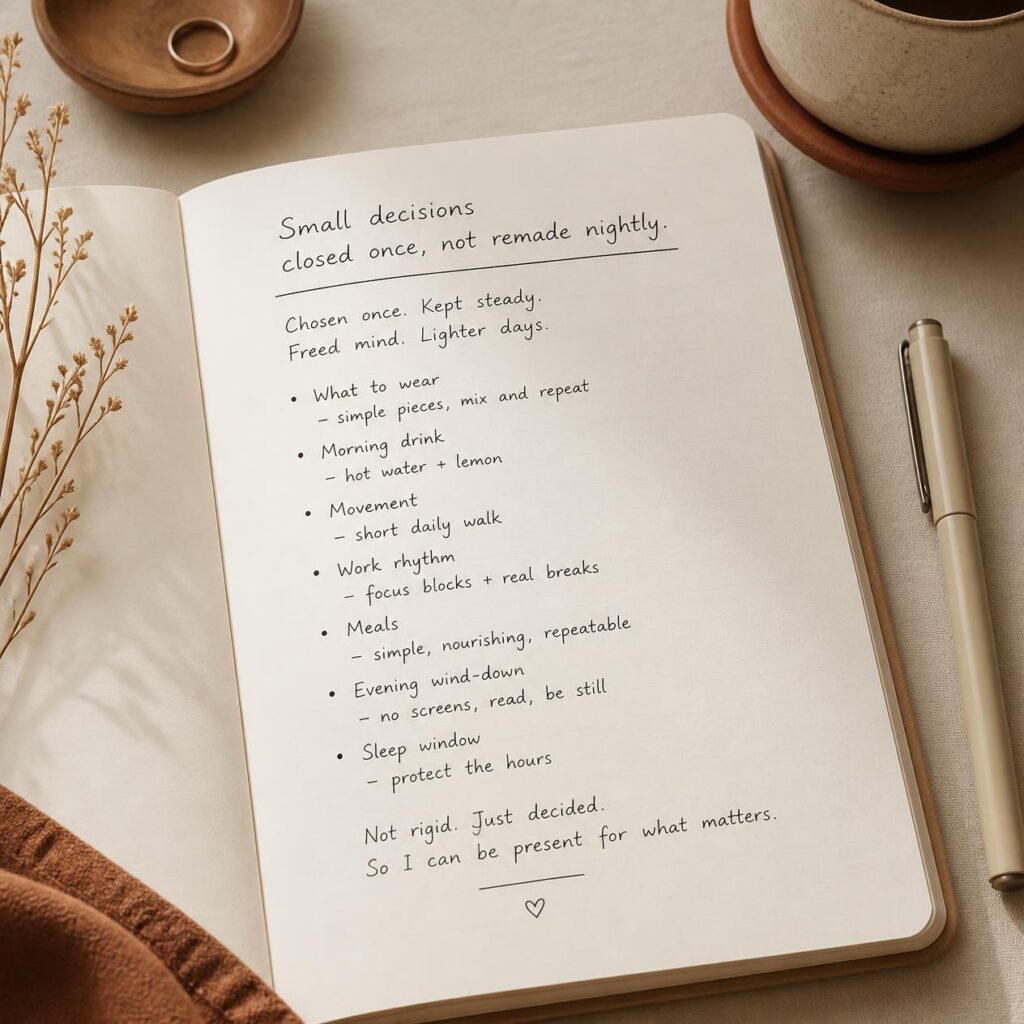
Here is the method. It takes about five minutes to set up and about thirty seconds per decision after that.
Step 1: Find the reopens
For two days, notice every time you decide something you have decided before.
You do not need to log it properly. A note on your phone is fine. You are looking for the phrase “what should I” and everywhere it repeats.
What is for dinner. What should she wear. Should I answer this now. What do we do about Saturday. Which coffee. Whether to reply to that message tonight or in the morning.
Most people find between eight and fifteen of these in forty-eight hours. That is eight to fifteen decisions, run daily, that you have already answered at some point in your life.
Step 2: Run the thirty second close
For each one, three questions. This is the actual tool.
Have I decided this before? If yes, it is not a decision. It is a re-decision, and re-decisions are where your evening goes.
Does the answer meaningfully change? Be honest rather than generous here. If the answer is roughly the same eight times out of ten, it does not change. It varies, which is different.
What is the good enough default? Not the best answer. The one that is fine. Write it down somewhere other people can see it.
That is the close. The decision is now made, permanently, and it stops arriving.
The tone matters more than the mechanics here. You are not building a rule for your household. You are removing a question from your day.
Step 3: Leave one door open
For every decision you close, keep one deliberate exception.
Thursday is the night anyone can suggest something else. Saturday is unplanned on purpose. One outfit day a week is a free-for-all.
This matters because closing decisions can start to feel like shrinking your life, and it should feel like the opposite. The exception is what makes it feel like a choice rather than a cage. It also means you keep the enjoyable decisions, which are usually the ones you never resented in the first place.
If this is landing, it is worth knowing which pattern is driving it, because closing decisions is the doorway for one of the four, and the other three need something different. Find yours in two minutes.
Nine decisions you can close this week

A starter list, because the hardest part is seeing them. Steal any of these.
- Weeknight dinners. Not a plan. Five defaults on the fridge, in handwriting, that anyone in the house can read and act on.
- Breakfast. Two options, permanently. That is it.
- What time you stop answering messages. One time, applied to everyone, so you are not deciding case by case at 9pm.
- The gift question. One default gift for kids’ birthdays, one for adults. Buy three of each in advance.
- What goes in the bag. One packed list, taped inside the cupboard, so leaving the house is not a fresh act of planning.
- The Saturday morning. Same shape every week, even loosely. The rhythm removes the negotiation.
- Which invitations get a yes. Decide the category once, not the individual case. This one is quietly the most freeing on the list.
- What you wear on the days that matter. One reliable outfit, no reconsidering at 7am.
- Where things live. Every item you have to decide the location of twice is an open decision wearing a disguise.
None of these are new systems. There is nothing to maintain, nothing to review, no app. You decide once, you write it down, you stop deciding.
Do not build a beautiful page for this. My Notion is immaculate. A museum piece. Nobody has ever used it.
What to do when the decision actually needs you
Some decisions are yours and should stay yours. The method is only useful if you are honest about which.
The test is simple. If you closed this and it turned out to be wrong, how expensive is that, and how easily could you reverse it?
Cheap and reversible: close it. That covers most of your day.
Expensive or hard to undo: keep it open, but move it. Real decisions deserve morning brain, not evening brain. If something important keeps getting decided at 9pm, the problem is not the decision. It is the slot.
And when a real decision arrives on a day when you have already made fifty small ones, it will feel enormous, and you will assume that is a sign it is complicated. Sometimes it just means you have nothing left. That is worth knowing before you conclude anything about the decision itself.
This is not really about dinner
Dinner is the easiest place to see it, which is why it is the easiest place to start. But the mechanism is not about food, and it does not require a household or children to apply to you.
The founder deciding the same three things about her business every Monday. The manager re-litigating a process nobody has written down. Anyone whose September rebuilds itself annually, which is the same pattern showing up as the whole year loading into your head rather than one evening.
Same mechanic. Small, repeated, reopened.
[JEN: optional, one line about a decision you closed recently and how it felt, or one you keep reopening and know you should close.]
If you want the broader version of this, here is how to lighten your mental load across a whole week rather than one category.
Frequently asked questions
How do I stop decision fatigue without meal planning or a new system? Close the decisions instead of scheduling them. Find the choices you remake daily, ask whether the answer meaningfully changes, and if it does not, write down one good enough default and stop revisiting it. There is nothing to maintain afterward, which is what separates closing from planning.
What causes decision fatigue in everyday life? Small repeated decisions, not big ones. Each one requires weighing several factors at once, and most of them arrive late in the day when you have the least available attention. The cost is invisible in any single instance and significant across a week.
Why is deciding more tiring than doing? Doing is one action. Deciding is holding several options open at once, comparing them, and being responsible for the outcome. That is why a twenty minute meal can feel easier than the four minutes spent choosing it.
How many decisions should I close at once? Start with three. Closing everything in one afternoon turns the method into a project, which is exactly the thing that makes people abandon it. Three closed decisions is a noticeably different week.
Is decision fatigue the same as mental load? It is one part of it. Mental load is everything you are keeping track of. Decision fatigue is specifically the cost of the choices inside that, and for some women it is the dominant part, which is what the pattern quiz is designed to tell you.
Start with one
You do not need to close nine decisions. Close one.
Pick the one that irritates you most, which is almost always the one that repeats most. Write down the good enough answer. Put it somewhere other people can see it, so you are not the only copy of it.
Not a system. Not a plan. Just one fewer question arriving at 5pm.
If you want to know why this particular thing drains you when other things do not, the two minute mental load pattern quiz will tell you which of the four patterns you lean toward, and what actually gives you relief. It is free, and it ends with a small tool you can use the same day.