

The back to school mental load usually starts with one email in early August. Something about shoe sizes, or a supply list, or a date you need to hold on to. You read it in nine seconds. And then your mind picks it up and carries it until June.
Back to school overwhelm is not the shopping. Not the drop-offs. Not the forms. It is the part where the whole school year loads itself into your head and stays there.
Here is what nobody in productivity culture tells you. The reason this season feels heavy is not that there is a lot to do. It is that you are the one holding the picture of how it all fits together. That invisible labor starts weeks before term does, and nobody counts it, including you.
Before you read on: how this shows up for you depends on how your mind carries it. The two minute quiz will tell you which of the four mental load patterns you lean toward, and the rest of this will make more sense once you know.
Why does back to school feel so overwhelming when you have not done anything yet
Nothing has happened. Term has not started. And you already feel behind.
That is because the work has started. It just does not look like work.
It looks like noticing the shoes will not fit by September. Remembering that one of them hated the lunch box by week three and you never replaced it. Registering that the club form closes before the first day, because last year it filled in an afternoon. Holding the date of the assessment week, the appointment you should book now while there are still slots, the gap in the second week that somebody is going to have to cover.
Nobody handed you those. You picked them up because you noticed them first, and you noticed them first because you always do.
That is the mechanism of the back to school mental load. It runs ahead of the season, it runs in a mind that is already full, and it leaves nothing behind that anyone could point to.
The back to school mental load is not a list. It is the whole picture
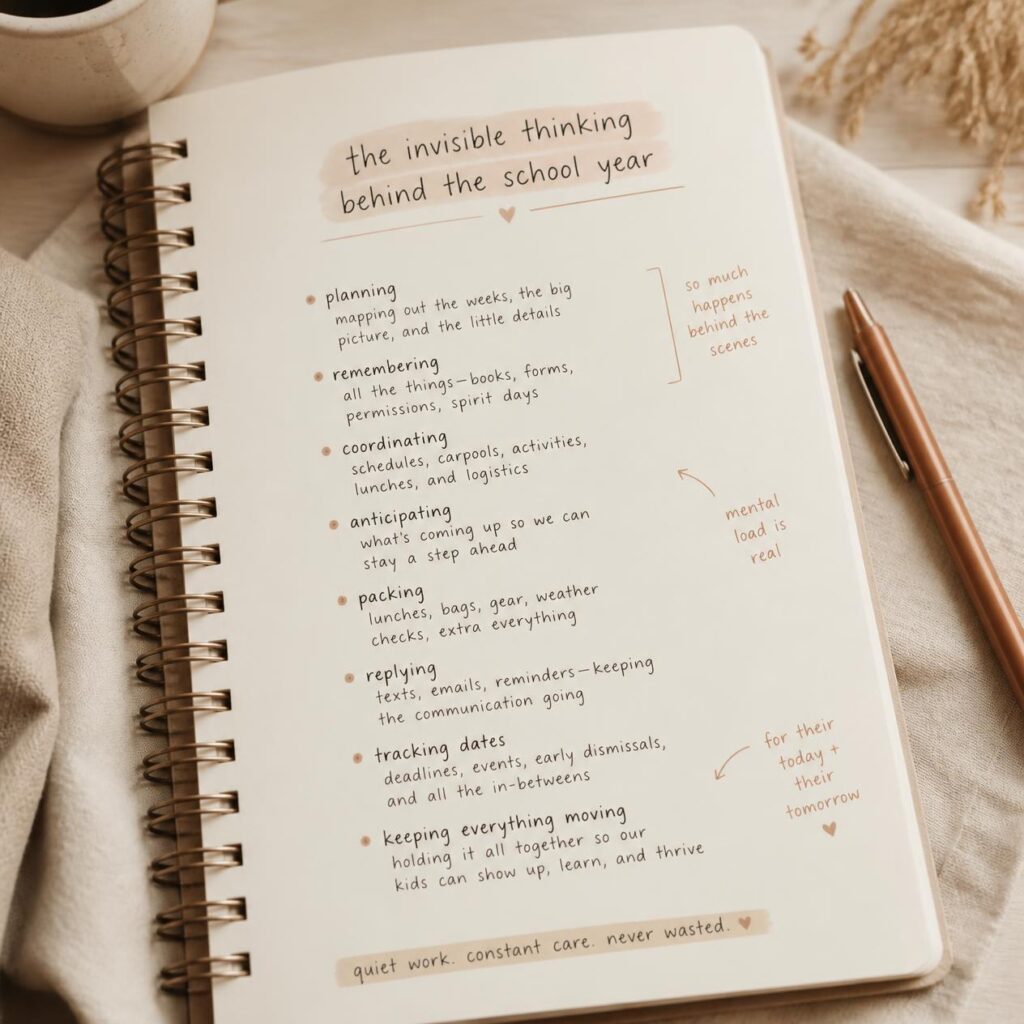
There is a real difference between doing tasks and holding outcomes, and it is the difference that makes this season so draining.
A task is buying shoes. An outcome is that everyone arrives in September with what they need, on the right days, in the right sizes, having eaten something, with the forms signed.
You are not managing tasks. You are managing outcomes. Which means you are the only person in the house running the full model of the year.
That model does not fit on a list. It lives in you.
And this is where the honest part comes in. When people tell you to just write it down and hand some of it over, they are not wrong exactly. They are describing a much smaller job than the one you are actually doing.
Back to school mental load: why help does not actually help
You have probably tried delegating this. It went one of two ways. Either you explained it for eleven minutes when doing it would have taken four, or it got done in a way that created a second thing for you to sort out on Thursday.
The context problem
You cannot hand over a task without also handing over the context.
The context is everything you know that nobody ever wrote down. Which emails from the school matter and which are automated. Who needs the appointment first. Why that one form is not actually optional.
So when you delegate, you’re not delegating a task. You’re delegating a task plus a briefing, and you are the only person who can give the briefing.
That is why handing over the school year often costs more than absorbing it. Not because you are controlling. Not because you will not let go. Because you are the only one holding the full picture, and the picture has to move before the task can. It is also why the tiredness never matches the task list.
If that part landed, it is worth knowing which pattern you are carrying, because the way out is different for each one. Find yours in two minutes.
What the back to school mental load actually costs you
The cost is not the hours. It is the holding.
We do not really talk about this part. You can be on vacation, on a patio, on the sofa on a Sunday afternoon with nothing asked of you, and some part of you is still building September. A woman on a forum this summer described real rest as having “zero to do lists haunting you.” Haunting is the right word. It is the difference between being off and being unoccupied.
It is also why the first three weeks of term feel like a sprint you never agreed to. You have been rehearsing them since the first week of August. By the time they arrive, you have already lived them once.
And there is a quieter cost underneath all of it. Nobody has ever thanked you for the thing you remembered at 11pm. The load is invisible by design, which means the effort is too.
I bought a beautiful planner once, specifically to stop holding everything in my head. It is on the shelf. In excellent condition.
How to reduce the back to school mental load: three piles
But here is what is true. You do not need a better system in the busiest month of your year. You need less in your head going into it.
So you’re not going to organize the school year. You’re going to sort what you’re already holding, once, before term starts.
Three piles.
1. What is truly yours
Some of this really is yours. Not because it was assigned to you, but because you’re the right person and you would want to be. The conversation with the teacher. The call about the club. Keep these. Name them. They stop feeling heavy the moment they stop being mixed in with everything else.
2. What can move to someone else, with its context
Take one thing. Not five.
Write down what somebody would need to know to own it properly, not just do it once. The deadline, the history, what goes sideways if it slips. That written context is the actual handover. Ten minutes now, and it covers the whole year.
Pick the thing that repeats most. That is where you get the most back.
3. What no longer needs to live with you
This is the pile most of us skip.
Some of what you’re carrying was true three years ago and is not true now. A standard you set when they were smaller. Something you took on during one hard term that quietly became permanent. A decision you have re-made every single August without ever asking whether it still needs deciding.
You can set those down. Not because they do not matter. Because they have already been handled, and holding them open costs you something every day.
A five minute back to school mental load reset you can do this week
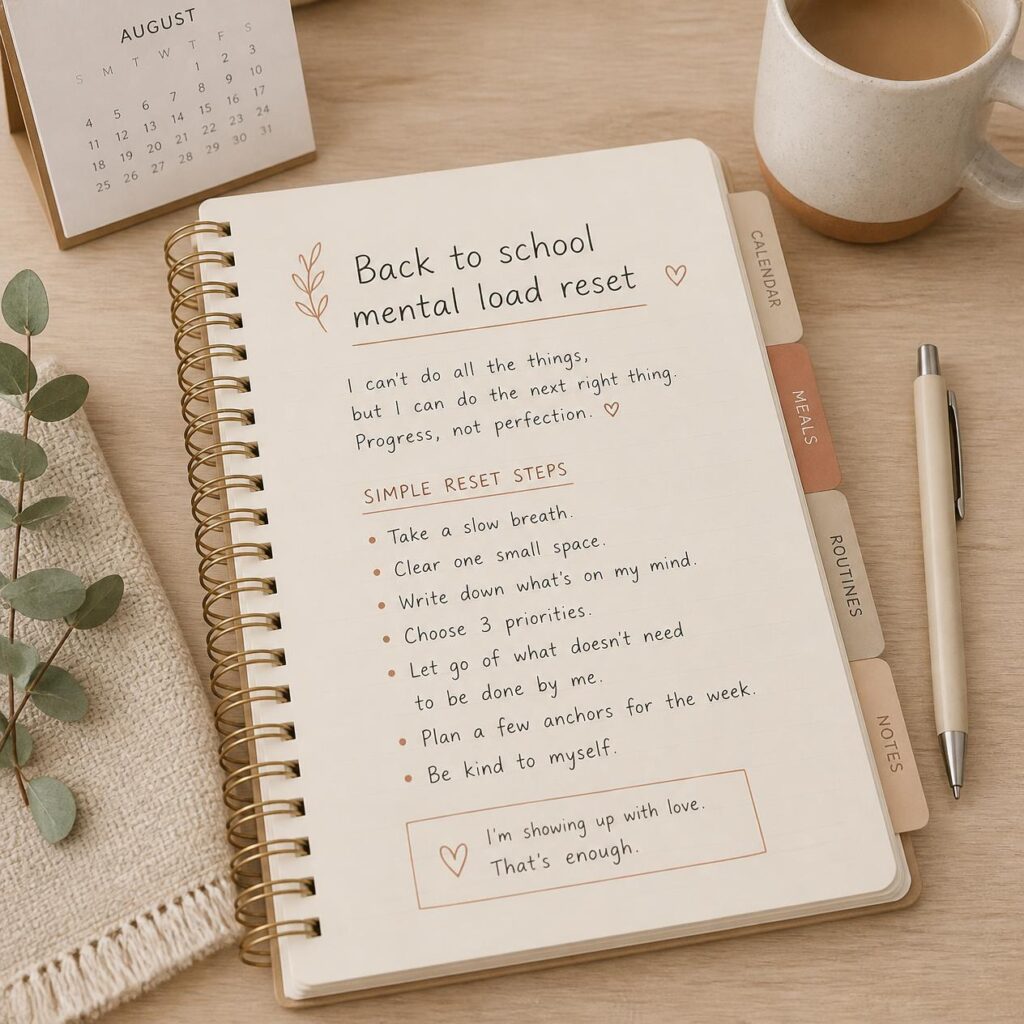
Because the audit should not become a project. You have enough projects.
Sit down with paper. Set a timer for five minutes. Write every single thing your mind is holding about September. No order. Badly. In fragments.
Do not organize it. Do not put it in columns. Do not open Notion.
When the timer goes, put a Y next to what is truly yours, an M next to what could move if someone had the context, and a line through anything that has stopped being necessary.
That is it. Five minutes, one page, nothing to maintain. The third pile is usually the surprise.
[JEN: optional, one line about the last time you tried to hold something in your head instead of writing it down, and how that went.]
Then close the notebook. The point is not a beautiful plan. The point is that the year is on paper now instead of inside you. If you want the same idea across a full week rather than one season, that is how to lighten your mental load more broadly.
If you do not have school-age kids, you still have a September
The back to school mental load is the loudest version of this. It is not the only one.
Something reloads in late summer for most of us. Budgets and Q4. Team schedules and hiring rounds. The business you’re building, coming out of its quiet stretch. Around 60 percent of senior-level women say they’re running on empty right now, and women take on roughly 200 extra hours a year of work that nobody gets promoted for.
Same mechanism. Same three piles. The forms are just called something else.
Frequently asked questions
What is the back to school mental load? It is the invisible thinking work behind the school year: remembering, anticipating, tracking deadlines, holding sizes and dates and preferences, and keeping the whole picture of how the year fits together. It is separate from the visible tasks like shopping or drop-offs, and it usually starts weeks before term does.
Why does back to school feel more overwhelming than the actual school year? Because the anticipating happens all at once. In August you are building ten months of logistics in advance, while the visible work has not started yet. Your mind is doing the heaviest part of the job during the part that is supposed to be restful.
How do I reduce the back to school mental load without adding another system? Sort instead of building. Five minutes, one page, three piles: what is truly yours, what could move to someone else if you wrote down the context, and what no longer needs to live with you. No app, no rebuild, nothing to maintain.
Why does delegating school logistics feel like more work? Because a task cannot move without its context, and you are the only one who has the context. The fix is to transfer that background once, in writing, for the thing that repeats most, rather than re-explaining a fresh task every time.
Before the year loads
You are going to carry some of this. That is not a failure of organizing. It is what happens when you’re the one who notices first.
But you do not have to carry all of it, and you certainly do not have to keep carrying the parts that stopped being necessary two Septembers ago.
Not a new system. Not a better planner. Just a quieter head going into September.
If you want to know which version of this you’re carrying, and which doorway actually gives you relief, the two minute mental load pattern quiz will tell you. It is free, and it ends with a small tool you can use the same day.